Jev-X · Models and applications
LLMs and JEV: From Generating Answers to Software Decisions
Six illustrations explain the differences between generative models and decision models, and how they can work together.
· An illustrated guide
We are used to asking AI to write articles, explain problems, and generate code. When AI becomes part of software that runs continuously, another set of questions appears: which category does this content belong to? Who should handle this request? Should the system proceed or wait when information is missing?
These questions led me to take an interest in JEV. It turns a model’s judgments into choices, scores, and probabilities that software can use. Understanding the differences between LLMs and JEV therefore starts with the tasks we need them to perform.
In this article, LLM refers to general-purpose generative large language models, while JEV refers to TypeSafe’s specific decision model. The comparison focuses on their design goals and how they are used; capabilities, interfaces, and performance also vary between LLMs.
Six questions in this article
- How does an answer become an action?
- What are LLMs good at?
- What does JEV provide?
- How should we compare them?
- How should we assess reliability?
- How does Jev-X use JEV?
01 · Once AI gives an answer, how does software act?
Suppose you read a large number of posts about AI every day. You can ask a model to summarize them in a few paragraphs, helping you quickly understand what happened that day. This is a generation task, and the result is primarily meant for a person to read.
An automatically updated information website needs more specific decisions: which posts are relevant? Which are tutorials? Which contain data worth saving? Software needs clear results to put posts into different sections or decide their display order.
The first task emphasizes expression and synthesis; the second emphasizes judgment and execution. One model might handle both, or different models might take on each task. This distinction helps explain where JEV aims to fit into an application.
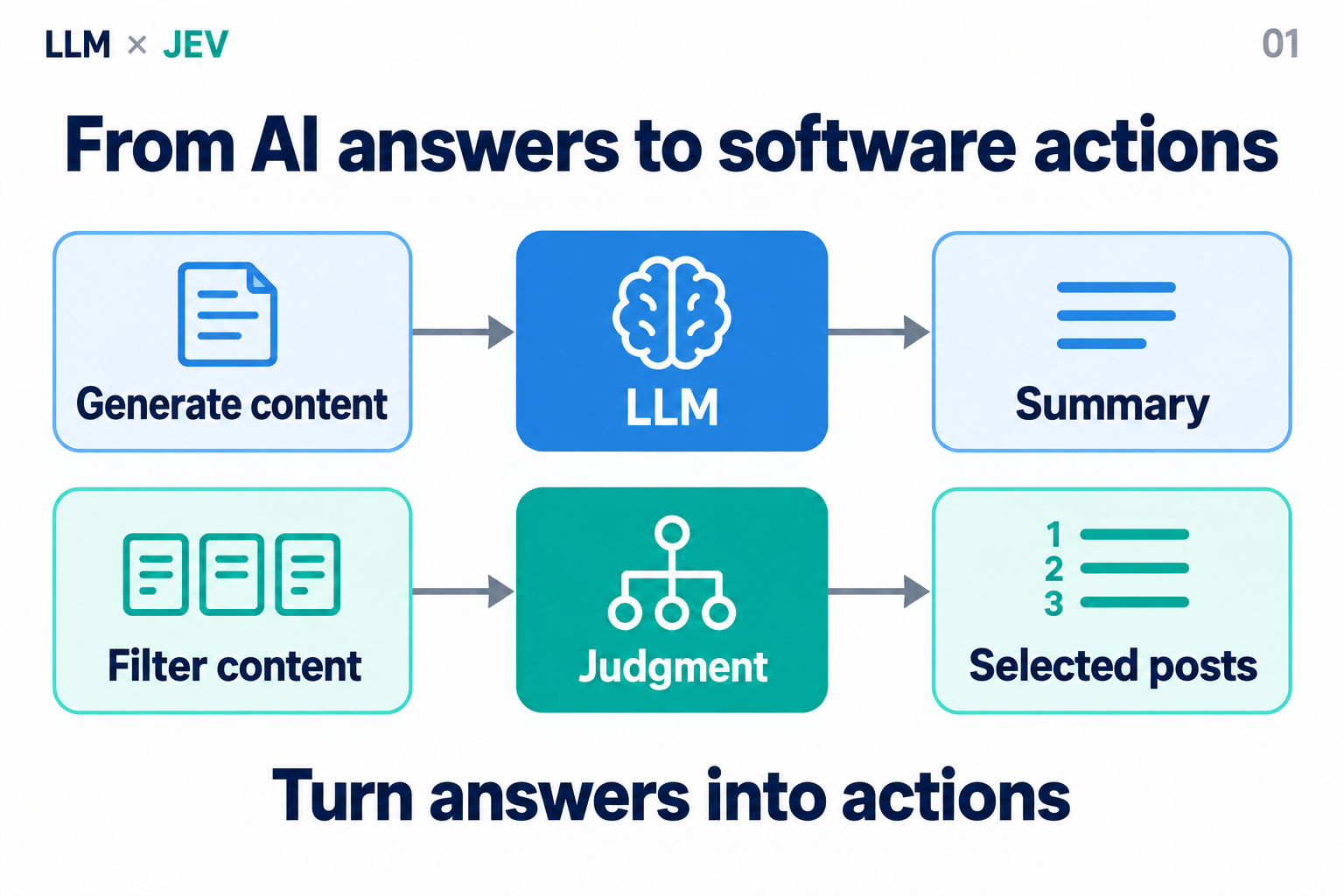
Generating content and filtering content place different demands on a model’s output. View full image ↗
02 · LLMs: flexible generation and reasoning
A major strength of LLMs is flexibility. Given a question and context, they can compose text, explain concepts, generate code, or suggest approaches to an open-ended problem. This is especially useful when we have not yet decided what the answer should look like.
LLMs can also classify inputs, return structured results, and use tools within a software workflow. In Building Effective Agents, Anthropic discusses routing: classifying an input and directing it to an appropriate next step.[2]
This flexibility also calls for evaluation: is the text accurate? Does the code pass its checks? Did the tools actually complete the task? In his review of LLM developments, Simon Willison emphasizes practical evaluation and understanding the capabilities and limits of models.[1] After a successful demo, a product still needs to be checked for consistent performance on real inputs.
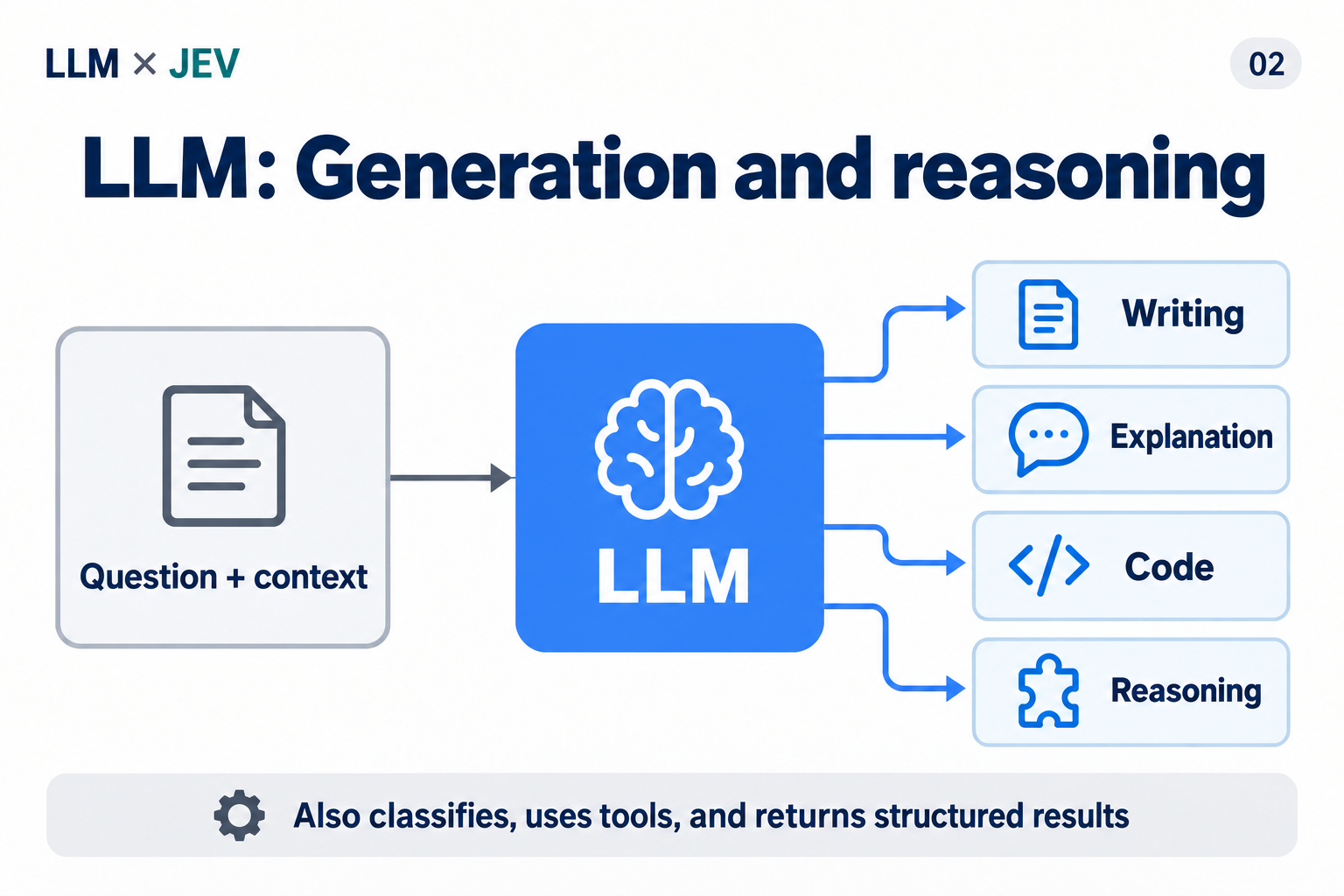
LLMs offer broad generative capabilities and can also make decisions within a clearly defined task. View full image ↗
03 · JEV: structured decisions for software
According to TypeSafe’s official description, JEV is its System One model. A request provides the current state and explicitly typed questions; the model returns decisions that software can use directly, without generating free-form text.[3]
The three basic types are easy to understand through examples: Choice selects from a supplied set of options, such as news, tutorial, or case study for a post; Score rates something against defined criteria, such as its information value; Noul returns the probability that a statement is true, such as whether a post is mainly about JEV.
This approach asks developers to define the questions, options, and scoring criteria first. Software then uses the results to filter, rank, and route inputs. A useful decision interface still depends on a clearly defined task.
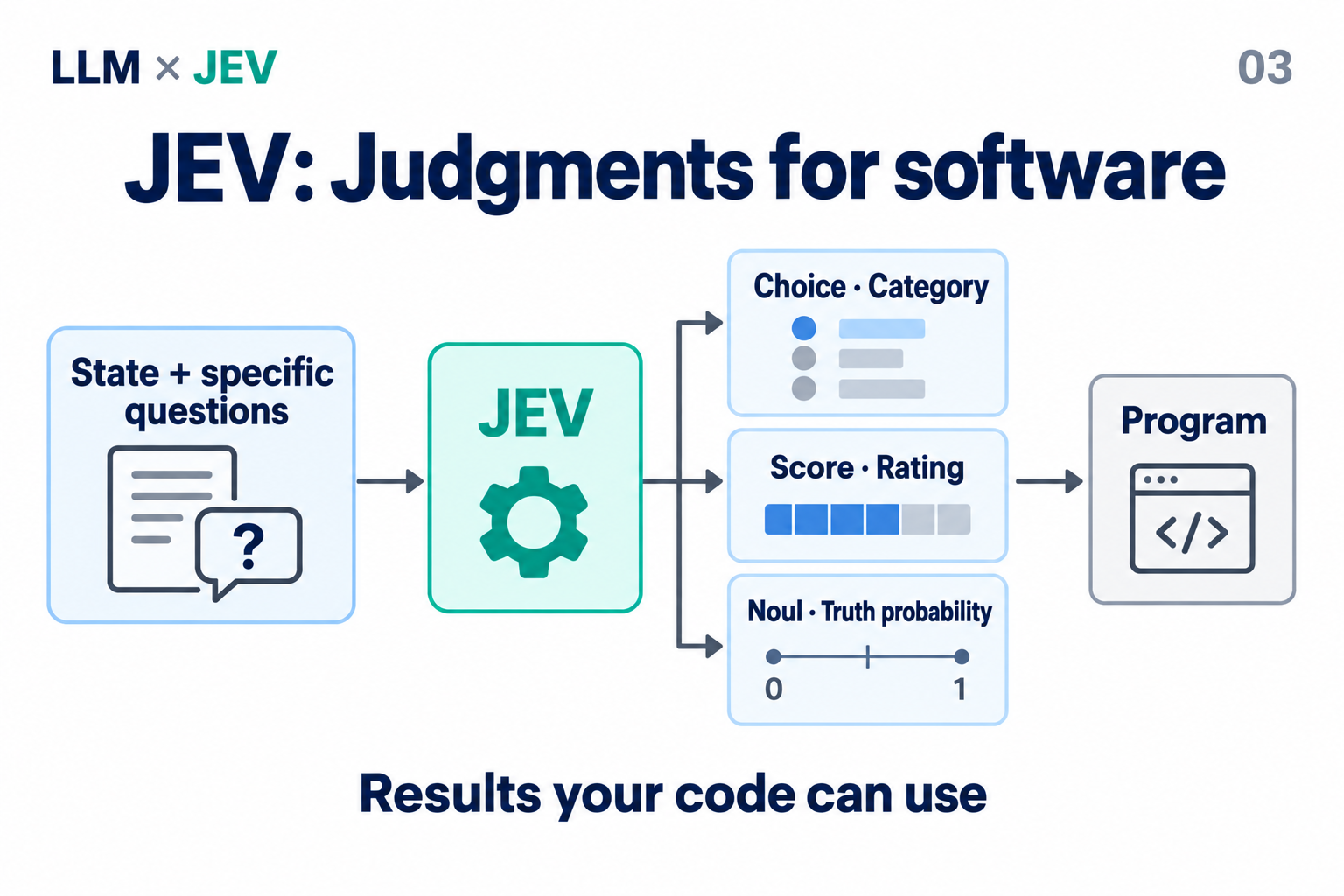
JEV supplies a judgment; software determines how to use it. View full image ↗
04 · If LLMs can output JSON, what is the difference?
This question deserves a careful answer. LLMs can already perform classification and produce structured outputs. JEV makes typed decisions the focus of its interface and training objective. TypeSafe calls its training method RLCD: reinforcement learning for calibrated decisions.[4]
A comparison can therefore consider task fit, output format, and evaluation separately. Using the same inputs, categories, and scoring criteria is necessary to determine whether a model better suits a particular workflow.
Two design approaches compared (swipe horizontally on narrow screens)
| Dimension | General-purpose generative LLMs | JEV |
|---|---|---|
| Tasks | Generation, explanation, reasoning, and classification | Focused classification, scoring, and routing decisions |
| Outputs | Text, with structured results available through suitable interfaces | Choices, scores, and probabilities within defined types |
| Uncertainty | Depends on the model, interface, and evaluation method | Provides probabilities; Choice and Score also provide confidence |
| Performance | Evaluate accuracy, latency, and cost for the specific task | Also requires measurement on the specific task |
TypeSafe’s launch article presents speed and cost comparisons, along with the testing conditions and possible sources of bias.[4] Those results are worth examining. In your own product, you also need to account for input length, request volume, network latency, and the cost of correcting wrong decisions.
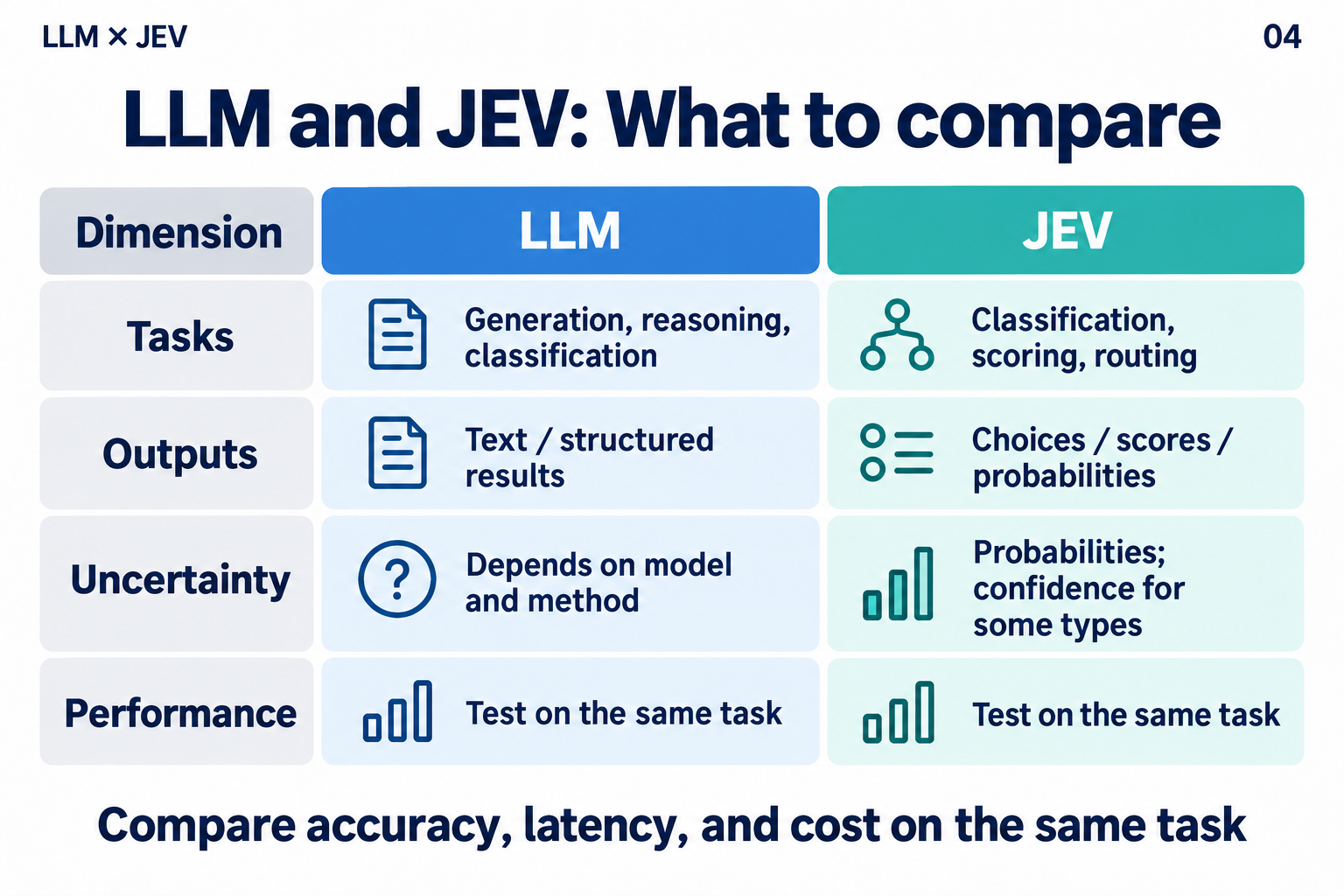
Interface features help guide selection; performance on real tasks determines suitability. View full image ↗
05 · A valid format can still contain a wrong decision
A result can follow the required format perfectly while selecting the wrong category. A model might also make a reasonable judgment, yet the system acts on it at the wrong time. Assessing reliability means checking three things separately: is the format valid, is the judgment trustworthy, and is the action appropriate?
JEV’s Choice and Score return probability distributions and confidence; Noul returns truth probabilities. According to the official documentation, confidence is a measure calculated from the shape of a probability distribution, reflecting how concentrated the model’s judgment is.[5] It supplies a signal for handling uncertainty, but even a high confidence value needs to be checked against actual outcomes.
Probability calibration can be understood through a simple question: across many similar examples, do events assigned a probability of about 80% actually occur about 80% of the time? Answering this requires data, rather than a single response. A confidence measure should not be treated directly as the probability that an answer is correct.
When designing a system, evaluation results and the cost of mistakes can guide the choice between automatic processing, human review, and deferring action. Different tasks need different thresholds. These strategies apply to both LLMs and JEV; a model interface still needs business rules and permission checks around it.
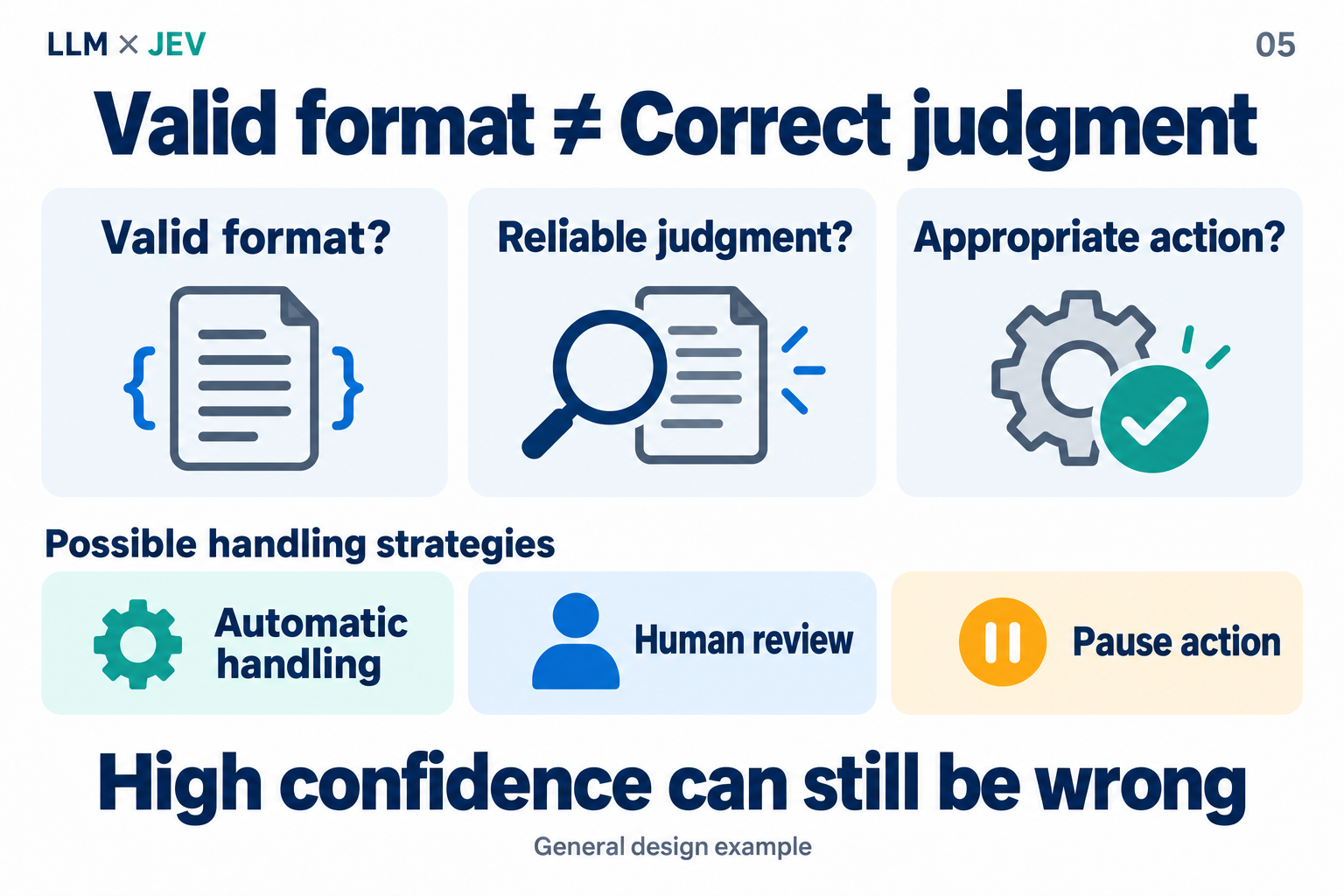
A general design example: choose a response based on task evidence and risk. View full image ↗
06 · Jev-X: adding content decisions to an information workflow
In Jev-X, when an X post enters the processing workflow, software sends its text, author, quoted content, and engagement data to JEV. One request makes three judgments: which category it belongs to, whether it is mainly about JEV, and how much information value it offers readers.
Categories organize the content, relevance helps filter it, and quality scores are combined with engagement data for ranking. When category confidence is insufficient, software falls back to keyword rules. JEV handles a defined decision step; software still performs the filtering and presentation.
This example helped me understand the value of decision models more concretely: where many keyword rules might otherwise need maintaining, we can try expressing the task through clear questions and scoring criteria. The model’s judgment is based on the content supplied to it. The current workflow does not have it read full linked articles or watch video footage, and the score represents information value for the intended readers.
Jev-X shows how JEV can be integrated into a real project. Model accuracy, probability calibration, and performance advantages still need separate evaluation; this application alone cannot establish that JEV outperforms other models across the board.
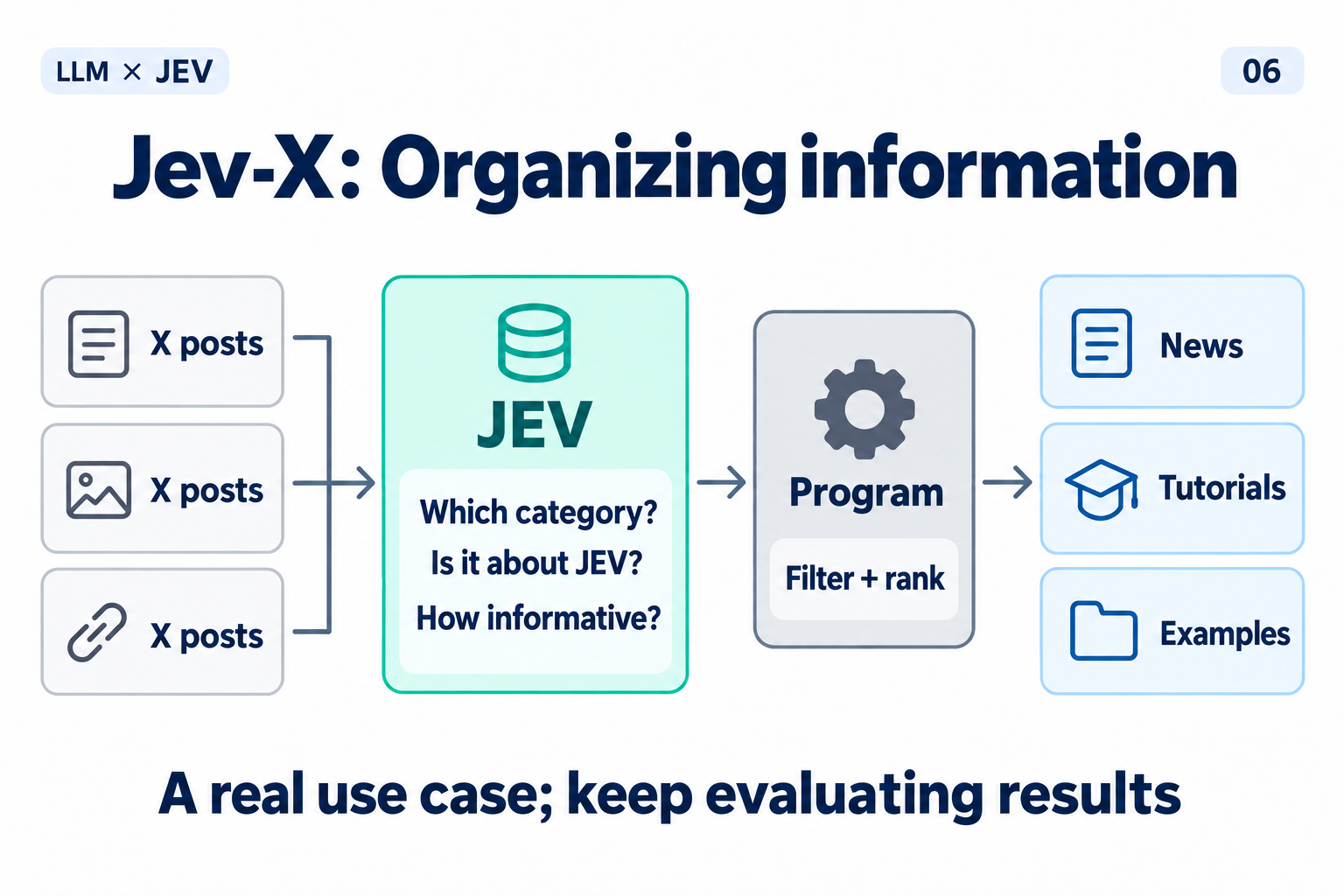
The practical division of work: JEV makes judgments; software filters, ranks, and presents content. View full image ↗
Divide the work by task, and test the value through results
LLMs offer a broad range of capabilities for generation, explanation, and open-ended reasoning. For repeated, clearly defined classification, scoring, and routing decisions, a decision model such as JEV is worth evaluating. Both can be part of the same workflow: identify the content and task type, then let an appropriate model handle the next step.
When choosing, I care most about practical questions: are the decisions accurate? Are mistakes easy to detect? Is less human review needed? Do latency and total cost meet the product’s requirements? These results determine whether a model can remain useful in the workflow over time.
I am optimistic about the direction JEV is exploring, and I want to keep observing it through Jev-X. Turn a model’s capabilities into a useful step in everyday software, then test the value of that step on real tasks.