
Treg
511.5K


 Quoted on Jev-X by @athrix_codes and 16 others
Popular posts about Jev on X, best ones first
Quoted on Jev-X by @athrix_codes and 16 others


 Quoted on Jev-X by @yakumo




 Quoted on Jev-X by @alacritic_super


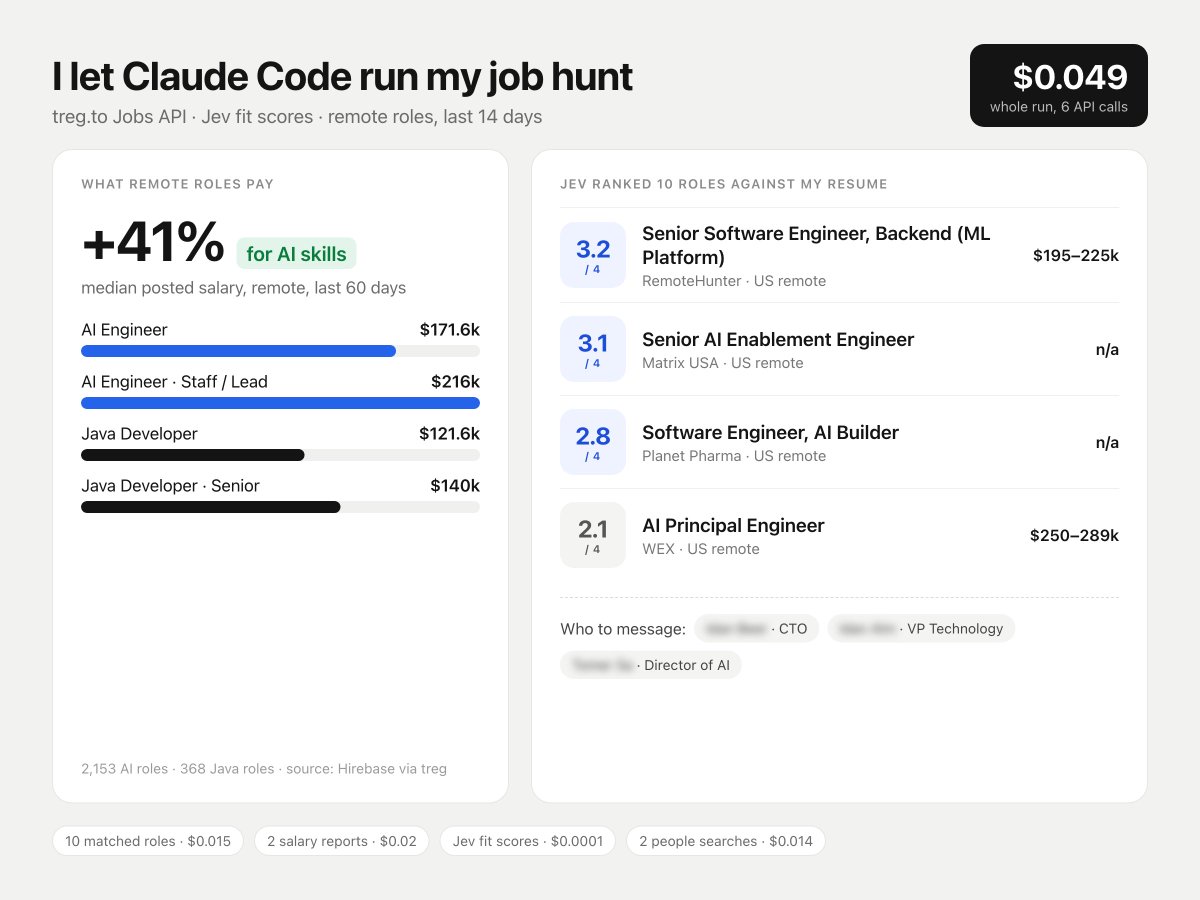
Introducing Jev @typesafeai powered jobs-api Try it at treg.to/jobs-api - One API to any jobs data - $0.03 to run a full job hunt - Real salary & Hiring manager data - Plugin to any agent for your dream job Fully open source, 0% markup Git Repo below 👇

Introducing Jev @typesafeai powered jobs-api Try it at treg.to/jobs-api - One API to any jobs data - $0.03 to run a full job hunt - Real salary & Hiring manager data - Plugin to any agent for your dream job Fully open source, 0% markup Git Repo below 👇

Introducing Jev @typesafeai powered jobs-api Try it at treg.to/jobs-api - One API to any jobs data - $0.03 to run a full job hunt - Real salary & Hiring manager data - Plugin to any agent for your dream job Fully open source, 0% markup Git Repo below 👇


Introducing Jev @typesafeai powered jobs-api Try it at treg.to/jobs-api - One API to any jobs data - $0.03 to run a full job hunt - Real salary & Hiring manager data - Plugin to any agent for your dream job Fully open source, 0% markup Git Repo below 👇


Introducing Jev @typesafeai powered jobs-api Try it at treg.to/jobs-api - One API to any jobs data - $0.03 to run a full job hunt - Real salary & Hiring manager data - Plugin to any agent for your dream job Fully open source, 0% markup Git Repo below 👇
Explore the latest discussions on X.
Jev is the first System One model from TypeSafe AI, built for automation and software decisions. Rather than generating conversational text, it takes an input state and directly returns typed decisions with calibrated confidence that software can use. Its training method is called RLCD (Reinforcement Learning for Calibrated Decisions). The official website claims that Jev is 193.6 times faster and 444.6 times cheaper than conventional LLMs for automation tasks. These figures come from the official website and have not been independently verified by this site.
Chat models excel at generating long text and performing multistep reasoning. System One models focus on quick decisions: given some content and a question with a clearly defined output type, they return a choice, a score, or a true-or-false judgment, along with the probability of each outcome. They suit decisions that software makes repeatedly, such as classification, routing, scoring, moderation, and tool selection.
RLCD stands for Reinforcement Learning for Calibrated Decisions. It is the method TypeSafe AI uses to train Jev. The goal is to align a model's confidence with its actual accuracy. For example, judgments made with 90% confidence should be correct about nine times out of ten, allowing software to use confidence to decide whether to act automatically or hand the decision to a person.
The official documentation defines three question primitives: Choice (selects one option from a set and returns each option's probability and confidence), Score (assigns a score against a rubric with 2 to 10 levels), and Noul (judges whether a statement is true and returns a probability from 0 to 1). A single request can ask multiple questions.
Get an API key from the TypeSafe console, send a POST request to https://api.typesafe.ai/v1/systemone, and set the model name to jev-latest. See the official documentation for details. Official Python and JavaScript SDKs are also available. According to announcements on X, Jev has also been integrated with OpenRouter, Cloudflare AI Gateway, and Vercel AI Gateway.
As of September 2026, the official documentation lists input at $0.042 per million tokens, with free output and a limit of 64k tokens per request. Prices and limits may change; refer to the official documentation for the current terms.
This site curates quality discussions in Chinese and English about the Jev model on X (Twitter), including open-source projects, integrations, tutorials, hands-on reviews, use cases, interviews, and news. It also tracks discussion activity by date. The site is maintained by the community and curated by @Web3wr. It is not affiliated with TypeSafe AI.
Posts are retrieved through twitterapi.io's advanced search API. The search includes posts mentioning both Jev (or System One or RLCD) and TypeSafe, excludes reposts, and also includes the latest posts from the official @typesafeai account. Popular picks refresh every hour, while daily statistics are collected in batches by the backend every 5 minutes.
Email hello@jev-x.com, or send feedback through Telegram or message @Web3wr on X. You can also recommend quality posts that we have missed.
Videos load directly from X's video servers. If your network cannot access X or X restricts playback, the card displays a notice and directs you to the original post on X to watch the video.
Daily picks and the 3-day hot list are ranked differently. Daily picks are ordered by Jev quality score from high to low, with newer posts first when scores are tied. The 3-day hot list only includes posts published in the last 3 days and is ordered purely by X engagement score from high to low, with newer posts first when scores are tied; the quality score is only used to filter out noise and does not affect the order. The X engagement score uses weights based on the recommendation ranking model X open-sourced in 2023: 0.5 per like, 1 per repost, and 13.5 per reply. How popularity is ranked → Picks rules
Views reflect exposure, and large accounts get many views regardless of what they post. Replies also carry a high weight in X's model, but posts such as giveaways asking people to reply with "1" can inflate their scores through reply farming. So this site ignores views: daily picks use Jev to judge how informative the content itself is and are ordered directly by quality score; the 3-day hot list is ordered by X engagement score, but first uses the quality score to filter out noise such as giveaways and engagement farming (posts with a quality score below 50, a failing grade, are not shown).
Each post is sent to Jev for classification and a Score question with 5 levels, then converted to a score from 0 to 100: noise (giveaways, engagement farming, or irrelevant content), pure emotion, an opinion, specific information (news, integrations, demos, or measured results), and worth saving (original insights, tutorials, open-source tools, or data). Jev also sees the types of links attached to the post, such as articles, GitHub, and videos, as well as engagement data such as the bookmark rate. Exaggerated promotion in all caps does not earn extra points. Post quality → Picks rules
Each post receives a quality score only once. The X engagement score is recalculated from the latest numbers on each refresh, and the 3-day hot list is ordered by it, so a post can still rise in the rankings if it becomes popular later.
Since Jev's release on September 15, 2026, the site has counted qualifying discussions about Jev on X each day: related posts with at least 10 likes, excluding reposts. The numbers are snapshots taken when posts are collected; view counts can continue to grow afterward. Long-tail posts with 0 likes are not included. Dates and times follow your time zone, matching X: each post is grouped under its publication date in your local time. Statistics use your local date from October 2, 2026; earlier statistics only exist as UTC-day totals and are kept as originally recorded.
Official (posts by @typesafeai), Integrations (platforms or frameworks integrating Jev), Open source (GitHub projects, CLIs, plugins, Skills, and open-source recreations), Competitors (comparisons with ChatGPT, Claude, Codex, and others), Tutorials (getting started, study notes, and explanations of concepts), Use cases (applications and demos built with Jev), Reviews (measured speed, cost, and accuracy), Interviews (podcasts, interviews, and talks), News (releases, funding, and user growth), and Opinions (other views).
Jev assigns categories through a Choice question. Each category includes a definition of what belongs and what does not, along with real examples. Jev's result is used when its confidence is at least 50%; below 50%, keyword rules provide a fallback. Hover over a card's category label to see the source and confidence.
Each day, classified qualifying posts are ordered by Jev quality score from high to low (newer posts first when scores are tied), and the top 50 are selected. Posts with a quality score below 50 (a failing grade) are not shown. The current day's data updates every 8 hours, is collected again after the day ends, and is finalized after another 24 hours.