Jev-X · How we curate
Heat and Quality Are Two Different Dimensions
X shows what people are discussing; JEV helps us decide what deserves a closer look.
· By Rich
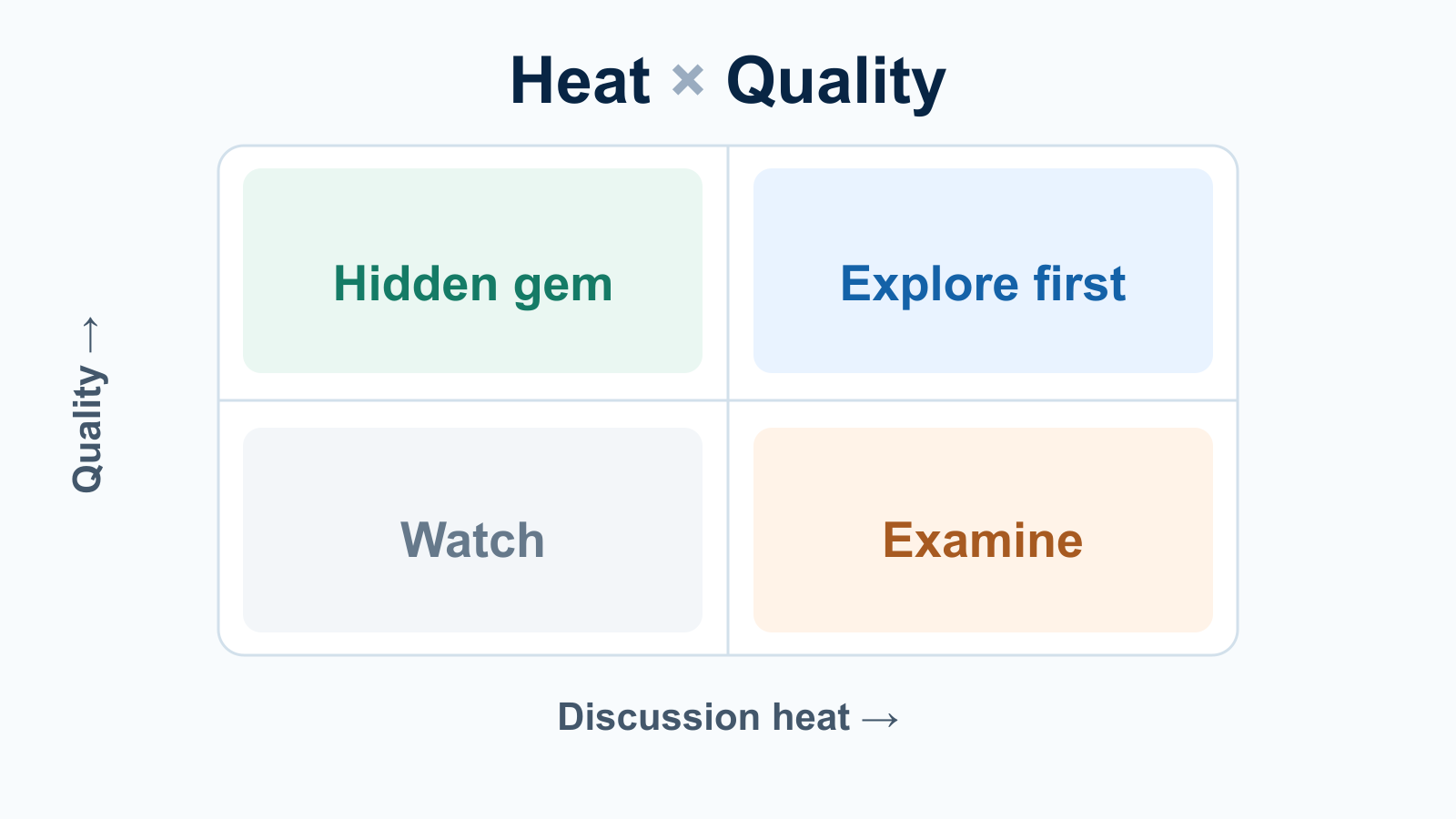
A project can be widely discussed, useful, both, or neither. Each deserves its own judgment.
When a new tool gets a lot of attention on X, you may want to try it immediately. Another repository may receive almost no mentions even though its documentation is clear and its demo runs. Heat helps us follow the conversation; quality helps us choose where to spend time.
This is a basic idea behind Jev-X: heat is a signal of attention; quality is a judgment about usefulness for a defined purpose. The numbers answer different questions. Seeing both gives readers a better starting point for their own decisions.
Many information products begin with popularity because likes, reposts, and replies are easy to count. Assessing the value of each item takes someone time to read it. Over time, being noticed can become a shortcut for being worth attention. Heat is still useful: it helps us follow new developments and see what a community cares about. It simply cannot carry the whole quality judgment.
Heat: what is being discussed?
The orange X Score on a project card summarizes engagement on X posts that mention it. Jev-X calculates a simplified score for each post, then adds those scores for the project:
X Score = likes × 0.5 + reposts × 1 + replies × 13.5
In the screenshot, the first post on the left has 190 likes, 29 reposts, and 26 replies. Its score is 95 + 29 + 351 = 475. A second post contributes 35.5, giving the project 510.5. This is a measure of weighted interaction around those posts. It does not tell us whether the repository installs, whether its documentation is complete, or whether its code is secure. With a high weight on replies, controversy can raise the number too. That is why the open-source ranking also shows quality separately.
Quality: useful for whom?
The blue quality score comes from JEV's assessment of a repository. The question is specific: how useful is this repository for someone building with Jev? The five levels are empty, code without a runnable explanation, runnable demo, documented and reusable, and mature and maintained. For link collections, the criterion is curation instead of code. The model mainly receives the repository description, an excerpt of the README, topics, language, and Stars. It does not run the code or audit its security. The page shows the latest code update separately, but that field is not currently passed to the repository quality model. “Mature and maintained” is a rubric label, not proof that maintenance was verified.
JEV returns a probability distribution over the five levels and an average score from 0 to 4. The page converts that average to 0–100. The 88 on the right of the screenshot can be explained by imagining 100 “virtual votes”: approximately 4, 5, 2, 13, and 76 votes for the five levels. The weighted result is (0×4 + 25×5 + 50×2 + 75×13 + 100×76) ÷ 100 = 88. No survey of 100 people took place; virtual votes are simply a way to visualize the model's probabilities. A score of 88 does not mean an 88% chance that the project is reliable.
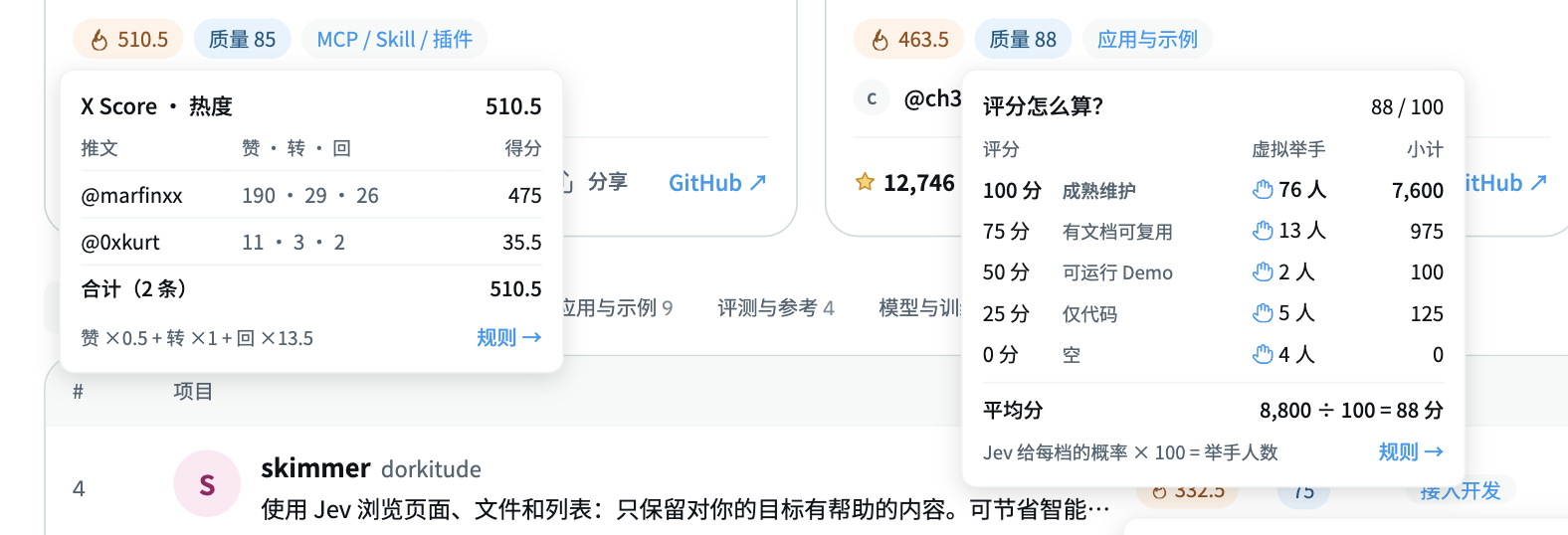
The two tooltips keep the source of discussion heat separate from the basis of the quality score.
Two dimensions, four useful reading choices
| Discussion heat | Quality judgment | What to do next |
|---|---|---|
| High | High | Read and try it first, then check the actual results. |
| High | Low | Understand why it is being discussed; examine hype or controversy carefully. |
| Low | High | Explore an overlooked project that may be useful. |
| Low | Low | Wait for more evidence or progress before investing time. |
These are suggestions for readers, not four automatic labels that Jev-X assigns to projects. The open-source ranking currently sorts by quality by default, then uses Stars, discussion, and the last code update to break ties. Readers can change the sort order, inspect the source post, and open GitHub to verify the project themselves.
Keeping both numbers visible also means we need not collapse different purposes into one opaque score too early. To follow today's conversation, start with heat. To find a tool you might integrate, start with quality. A disagreement between the two is itself a useful reason to look more closely.
The benefit of JEV: making quality triage routine
Consistently finding useful projects with little attention used to mean repeatedly reading descriptions, scanning READMEs, and comparing unlike projects by hand. Each new candidate added more work. JEV lets us apply the same explicit question and five-level rubric across candidates, produce an inspectable first judgment, and reserve human time for trying projects and reviewing ambiguous cases.
Low model cost makes it more feasible to look beyond the hottest few projects. As a scale example, on October 14, 2026, TypeSafe's website listed JEV at $0.042 per million input tokens with free output tokens.[1] At an assumed 3,000 input tokens per assessment, the model charge would be about $0.000126; 10,000 assessments would cost about $1.26. This is an illustration using list price and assumed usage, not Jev-X's measured bill. It excludes data collection, storage, and human review, and pricing may change.
The shift is less about scoring the ten most popular projects and more about giving emerging, overlooked candidates a first pass too. Broader coverage could help surface useful tools before their posts spread widely. Whether it actually does is a product outcome to test, not an automatic consequence of a cheap model call.
Lower cost makes it easier to turn “assess first, then decide what to read” into an ongoing workflow. The judgments still need checking. A polished README may describe code that does not run, and a recent commit alone does not establish maintainability. When a score conflicts with the visible evidence, we should inspect the repository and use such cases to improve the rubric.
Heat shows where a community's attention is going. Quality helps us decide where our own attention should go. JEV's contribution here is to make a once expensive, irregular first pass repeatable across many candidates, with a basis that readers can inspect. Whether to adopt a project still depends on your needs and your own verification.