Jev-X · Technology and belief
From BTC and EVM to GPT and Jev: Why I Believe in the Future of Decision Models
New foundational capabilities open up new possibilities for applications. I want to follow, experiment with, and document this emerging direction from the beginning.
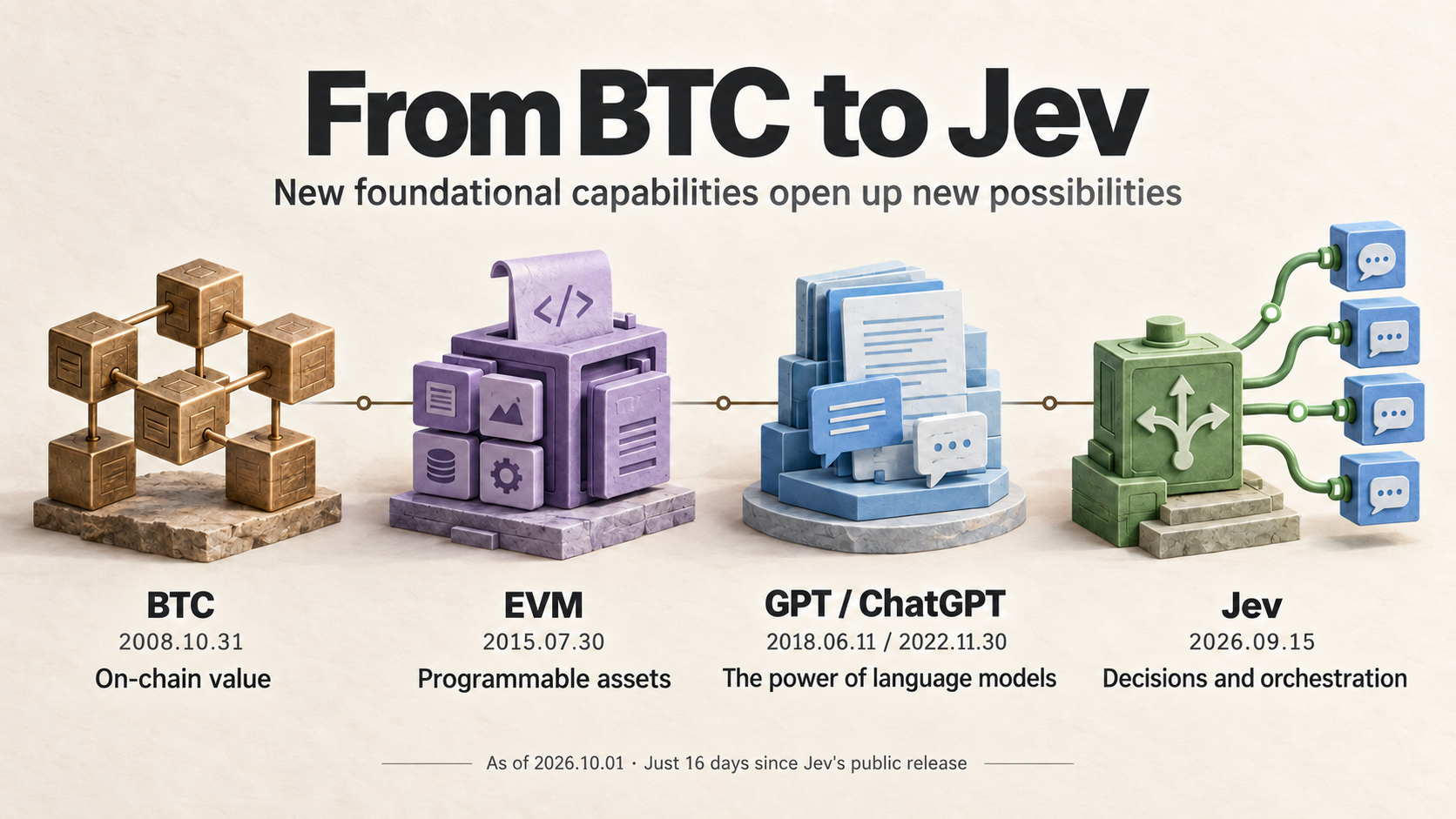
I’m interested in Jev because it has made me ask a question: when language models can already do so much, how can we organize those capabilities into workflows that keep running?
Looking back at the development of BTC, EVM, and GPT, I see a pattern worth following: once a foundational capability emerges, new ways of organizing and using it continue to create room for new applications.
I believe decision models are exploring that space. Jev is one direction that makes me want to keep following, experimenting, and participating. It is also why I started building Jev-X.
First, let’s put a few important milestones together:
-
BTC white paper
The Bitcoin white paper introduces a peer-to-peer electronic cash system.[1]
-
Ethereum mainnet launch
Ethereum launches, with EVM providing an execution environment for smart contracts.[2][3]
-
The first GPT research
The first GPT research explores generative pre-training.[5]
-
ChatGPT launch
ChatGPT gives more people a direct way to experience language models.[6]
-
Jev’s public launch
Jev launches publicly, opening up exploration of decision models in software workflows.[7]
From BTC to EVM: how foundational capabilities open up applications
BTC demonstrated a new kind of value network: people could record and transfer value through a decentralized network. The blockchain technology behind it also provided a foundation for further exploration.[1]
As this foundational capability developed, another question opened up: beyond transferring value, what else could we do on-chain?
Ethereum and EVM expanded that space.
EVM, the Ethereum Virtual Machine, provides an execution environment for smart contracts. Developers can write rules as programs, allowing assets to be issued, managed, exchanged, and combined according to those rules.[3]
Tokens, stablecoins, NFTs, and the trading, lending, and governance systems built around them gradually expanded on-chain assets and activity. More types of assets gained ways to participate in on-chain applications, and developers could build new products around them.[4]
I find this development instructive: a foundational capability can create value, and making it programmable and composable can expand its uses further.
GPT showed us the power of language models
When I look at AI, I have begun to ask similar questions.
The development of GPT, especially the arrival of ChatGPT, gave us a direct experience of what language models can do. Writing articles, explaining concepts, organizing research, translating content, generating code: many tasks can begin with a conversation.[5][6]
LLMs have already demonstrated powerful capabilities. Connecting those capabilities to real work has become another question worth exploring seriously.
A complete task usually involves many decisions. Is the available information sufficient? Should we research first or generate an answer directly? Which model should we call? Does its output meet the requirements? Should we keep processing or ask a person to review it?
These decisions determine how a model’s capabilities are used, and they affect the efficiency and quality of the whole workflow.
Jev: connecting decisions to execution
This is what draws me to Jev.
A common way to interact with an LLM is to provide text and receive generated text. It excels at expression, explanation, and reasoning, but its output still needs to be understood, checked, and translated into the next action.
Jev is designed for specific decisions. Give it the current state and a question, and it returns a choice, a score, or a probability for a true-or-false decision that software can use directly. The input state can contain text, while the output is a structured decision result. Classification and scoring also provide probability distributions and confidence, allowing software to handle uncertainty in a decision.[8]
These decisions can return quickly and fit naturally into workflows.
A program can use the result to select a model, call a tool, filter information, or decide whether human review is needed. Decision quality still needs to be evaluated for the specific task, but the structured interface makes it easier to connect decisions with execution steps.
That is why I think Jev can serve as a decision layer that directs the work of LLMs.
“Directing” can mean very specific things: identifying the type of task, selecting a suitable model, passing it the material to process, and deciding what to do next after checking the result.
Jev provides the decision, the program handles orchestration, and the LLM performs tasks such as writing, explaining, generating code, and complex reasoning.
TypeSafe’s documentation already demonstrates this collaboration: calling different LLMs according to the request type, or asking a smaller model to extract information, checking the result with Jev, and escalating to a stronger model when needed.[9][10]
Connecting generation and decisions into a workflow
For example, we could design a workflow for organizing information like this:
Collect material
Provide the material to process and the task requirements as the current state.
Jev filters relevant content
Decide which material is relevant so the program can arrange the next steps.
An LLM generates a summary
The program passes the selected material to a language model to produce the summary.
Jev checks source support
Evaluate whether the key claims in the summary are supported by the source material.
The program chooses the next step
Use the decision to continue processing or send the result for human review.
Each step has a clear question and a corresponding action. Generation and decision-making can work together in a system that keeps processing tasks.
This brings me back to the lesson I take from EVM: when foundational capabilities can be organized and combined through programs, people have room to build more applications around them.
I hope decision models can play this kind of role in AI workflows: helping models, tools, and execution steps work together, and applying the capabilities we have already seen to more practical problems.
Jev is still young, with much left to explore
One thing is particularly worth remembering: Jev has been public for a very short time.
As of October 1, 2026, just 16 days had passed since Jev’s public launch.
The examples and tools we see today are among the earliest experiments. Which tasks it suits, how it can work with different models, and how it can become part of everyday software workflows all leave plenty of room for developers to explore.
The development of BTC and GPT makes me more willing to give new technologies time. A technology’s value unfolds through continued building, real use, and ongoing improvement.
I believe the direction Jev represents will prove its value through time and real applications.
Why this led me to build Jev-X
That belief also makes me want to start doing something concrete now.
X has an enormous amount of information every day. Important updates, thoughtful evaluations, inspiring open-source projects, and experimental applications that have received little attention can easily become scattered across the feed. We can read a great deal and still miss the developments we care about.
So I built Jev-X, hoping to gradually bring this content together, make important information easier for people interested in Jev to find, and reduce the time spent searching for it again.
I also use Jev to classify relevant discussions and score their quality, applying the technology I’m following to a real information-filtering problem. Through continued use, I can keep learning about its capabilities and limits, then share the experiments worth following with others.
Jev is still very young. I want to keep following it, trying it, documenting its development, and gradually improving Jev-X.
There is still a great deal of room for it to grow, and I believe time will prove its value. That is what I believe, and why I have started taking action.